The Advantage of FMS in Modern Fleet Management

In high-density commercial markets like the UAE, fleet management is no longer a game of spreadsheets, manual logbooks, and reactive roadside recovery. A modern Fleet Management System (FMS) is the single operational bridge between vehicle profitability and crippling downtime.
Operating 20, 50, or 300+ commercial vehicles across Dubai, Abu Dhabi, and the Northern Emirates exposes businesses to extreme operating conditions. Ambient temperatures exceeding 45°C, fine abrasive sand dust, stringent municipal mandates, and aggressive multi-drop delivery schedules mean that traditional calendar-based servicing is fundamentally broken.
When maintenance decisions are delayed by fragmented communication between drivers, workshop mechanics, and procurement teams, an avoidable $80 sensor replacement escalates into a catastrophic $4,500 engine failure. Here is how modern Fleet Management Systems fundamentally alter this dynamic.
Modern FMS shifts fleet operations from reactive crisis management (dealing with breakdowns on Sheikh Zayed Road) to predictive control (resolving thermal degradation 1,200 km before a fault code triggers).
1. The Elimination of the "Blind Spot": Real-Time Telematics & Diagnostics
Historically, fleet managers only learned of a vehicle problem when the driver called from the side of the road. Modern FMS platforms integrate directly with OBD-II and CAN-bus telemetry to stream live operational health data.
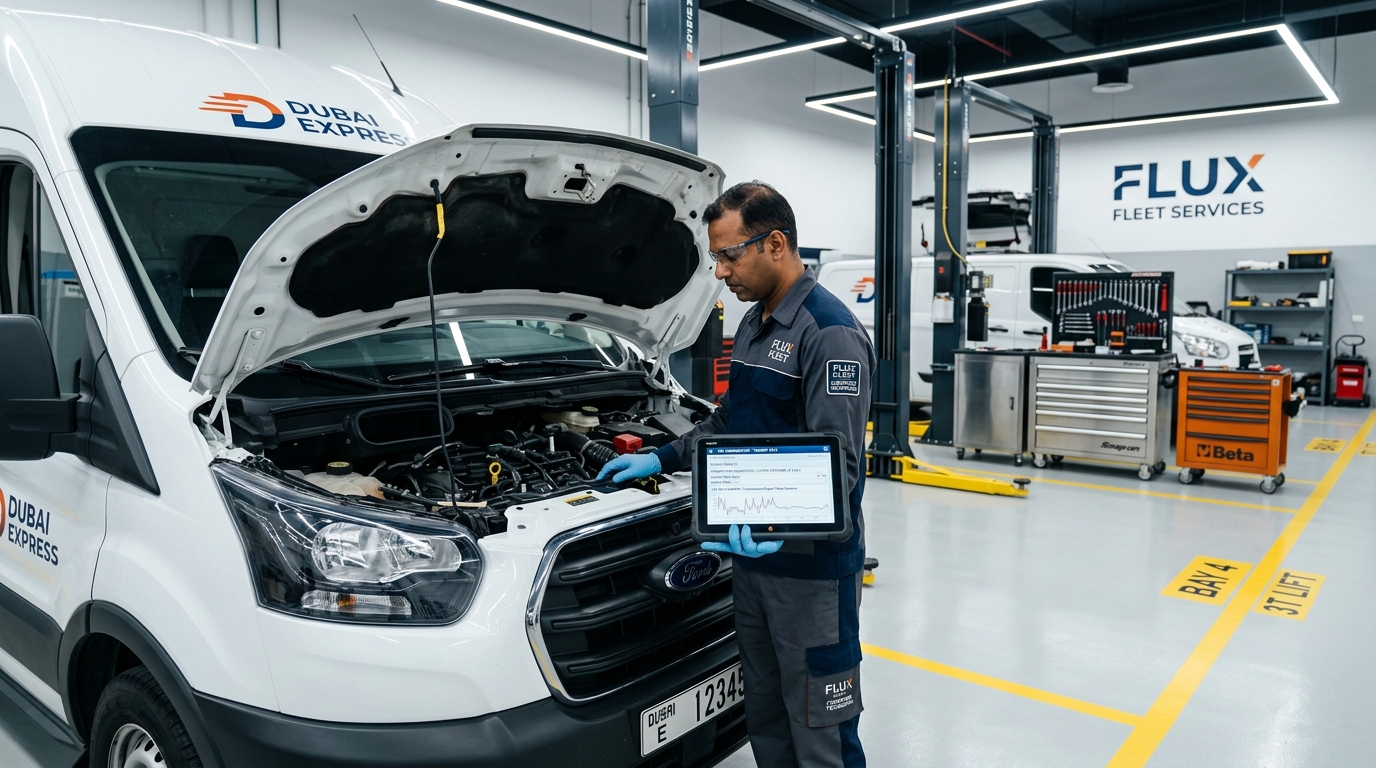
Instead of simply reporting GPS coordinates, an advanced FMS tracks coolant temperature curves, alternator voltages, exhaust gas temperatures, and transmission load in real time. If a delivery van in Al Quoz experiences abnormal coolant pressure under 46°C ambient heat, the system flags the issue before the engine overheats.
2. Predictive Maintenance Over Arbitrary Mileage Intervals
Standard operating manuals recommend oil and filter changes every 10,000 km. However, 10,000 km of high-speed highway cruising on the E11 generates vastly different wear compared to 10,000 km of stop-and-go courier delivery with idling engines running air conditioning at full blast.
An FMS calculates engine hours, thermal cycles, and fuel-burn ratios to establish stress-based servicing intervals. Fleets operating under extreme load are serviced proactively, preventing oil breakdown and sludge formation that silently destroys turbochargers and internal seals.
3. Digital Work Orders & Workshop Bay Transparency
One of the largest hidden drains on fleet profitability is workshop opacity. When a vehicle enters a garage, managers often face vague estimates, disputed labor hours, and multi-day delays waiting for parts approval.
Modern FMS ecosystems like FleetFix introduce digital job cards with standardized labor times, photographic proof of required repairs, and automated LPO generation. Every repair is timestamped, quality-checked, and benchmarked against industry averages, eliminating bogus workshop line items.
4. Streamlined UAE Regulatory Compliance (RTA & Asateel)
In the UAE, compliance is directly tied to uptime. Missing an annual Mulkiya registration renewal, failing technical safety testing, or falling out of compliance with the Abu Dhabi ITC Asateel platform or Dubai SecurePath regulations results in heavy fines and vehicle impoundment.
A tailored FMS automatically monitors vehicle registration expiration, insurance policy renewals, driver license validities, and municipal test schedules, alerting operators 30 and 60 days in advance to prevent administrative paralysis.
5. Total Cost of Ownership (TCO) Reduction
By consolidating fuel cards, tire wear logs, preventative maintenance schedules, and warranty-backed parts sourcing, an FMS provides an undeniable financial advantage:
- 24% to 32% Reduction in Unplanned Breakdown Costs: Proactive minor fixes eliminate major component replacements.
- 15% Improvement in Fuel Efficiency: Eradicating prolonged idling, under-inflated tires, and aggressive driver braking habits.
- Optimized Asset Lifespan: Commercial vans and light trucks deliver an extra 2 to 3 operational years before requiring capital replacement.
Conclusion: The Hybrid Model
Software alone cannot change a tire or rebuild an alternator. The true competitive advantage occurs when intelligent FMS software is directly paired with dedicated field advisors, mobile technicians, and vetted garage bays—the very foundation of the FleetFix ecosystem.
Written by
FleetFix Technical Operations
Commercial Fleet Engineering Team, Dubai UAE
Related Articles
Continue Reading Fleet Intelligence
 Cost & ROI
5 min read · Published Nov 2026
The Hidden Drain of In-House Parts Sourcing: 1,200 LPOs Analyzed
 UAE Regulations
4 min read · Published Oct 2026
Asateel & SecurePath 2026: Navigating Mandatory Telematics
 Diagnostics
8 min read · Published Oct 2026
Diagnosing Transmission Slip Under Extreme Gulf Load (Code P0730)
Benchmark your fleet uptime against UAE leaders.
Connect a 10-vehicle pilot fleet to FleetFix. We evaluate your active work orders, historical parts spend, and telemetry data to reveal immediate operational savings.
98.4%
On-Time Handover
28%
Average Cost Drop
45m
UAE Field Response
100%
Vetted Workshops